
On this page, students can learn more about the cello and also how to read and write music for the cello
The music theory for cello students on this page correlates with the Flipped Strings Cello Book 1 and the Flipped Strings Cello Apple iBook 1 with embedded media.
Navigating this page
Click on the topic you wish to view to go to that section of this page. Teachers, you can show the videos to your class and print as many of the PDF worksheets as you wish. Students, you can work through each of the lessons, print and complete the worksheets and then play each of the exercises on your instrument, so you better understand how not only how to write music for your instrument but also how to play what you have written. This might even lead you to compose and perform your own music.
Menu
- About the Cello
- The Bass Clef
- What Are Open Strings
- 1. Writing & Reading Basic Note Values on Open Strings
- 2. Writing & Reading Rests
- 3. Writing & Reading Rhythm in Different Time Signs
- 4. Writing & Reading Rhythms – Barlines
- 5. Sharps – Raising Notes a Semitone
- 6. Writing & Reading Notes Using 1st Finger
- 7. Writing & Reading Notes Using 3rd Finger
- 8. Writing & Reading Notes Using 4th Finger
- 9. Writing & Reading D Major Scale & Arpeggio
About the Cello
The cello plays lower sounding notes than the violin. It often plays a bass line in the orchestra but can also play a low melody part.
Flipped Strings Cello L1 with MP3s copy.pages
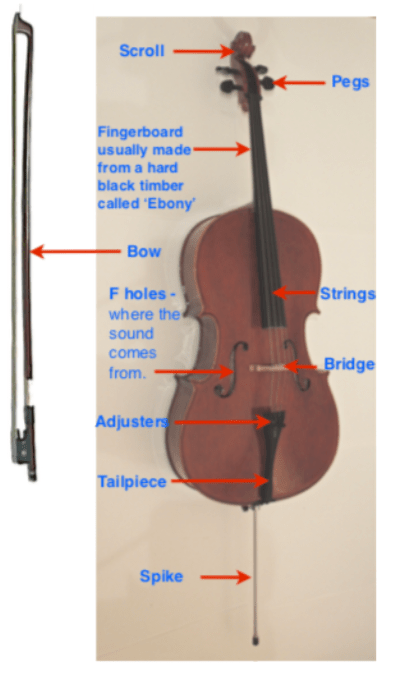
The cello (full name – Violoncello) was developed from an older instrument known as the Viola Da Gamba around the 1600s. It is mainly bowed like the violin and viola but is also sometimes plucked.
It is played sitting down with the cello held between the knees. The earliest version of the cello did not have a spike and had to be supported by the player’s knees. It is much easier to play the modern cello with the spike being adjustable to support it and the cello leans back against the left side of the cellist’s chest.
The cello is a versatile instrument and plays the melody, harmony or bass part in the modern orchestra. It can display a wide range of tones from a deep resonance on the C string to high bright notes on the A string.
As well as being used in classical ensembles such as the string quartet, chamber orchestras and the modern symphony orchestra, the cello has also been used more recently in rock groups and popular music.
Click here to return to the menu
The Bass Clef
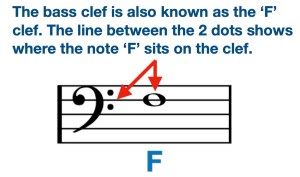
Notes on the lines of the bass clef

Click here to learn more about ledger lines
Notes on the spaces of the bass clef

Click here to return to the menu
What Are Open Strings?
The very first thing we must learn about the cello is the open strings. What is meant by “Open Strings?”
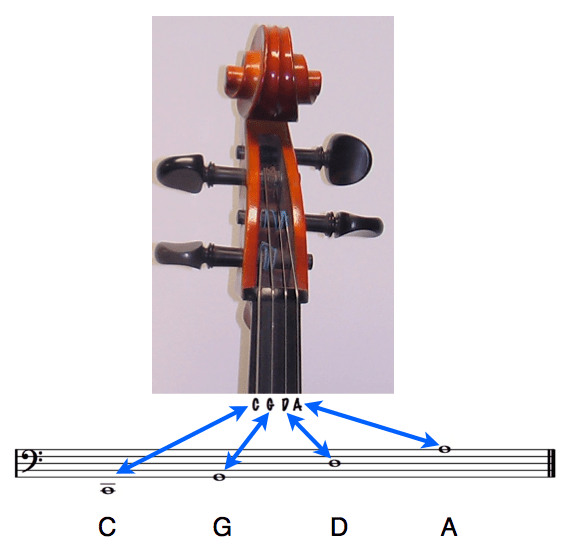
An open string on any stringed instrument is when you draw the bow across the string without placing a finger on fingerboard to change the pitch. There are 4 strings on the cello – therefore there are 4 definite fixed pitches that we can play on the cello without having to use the fingers in our left hand.
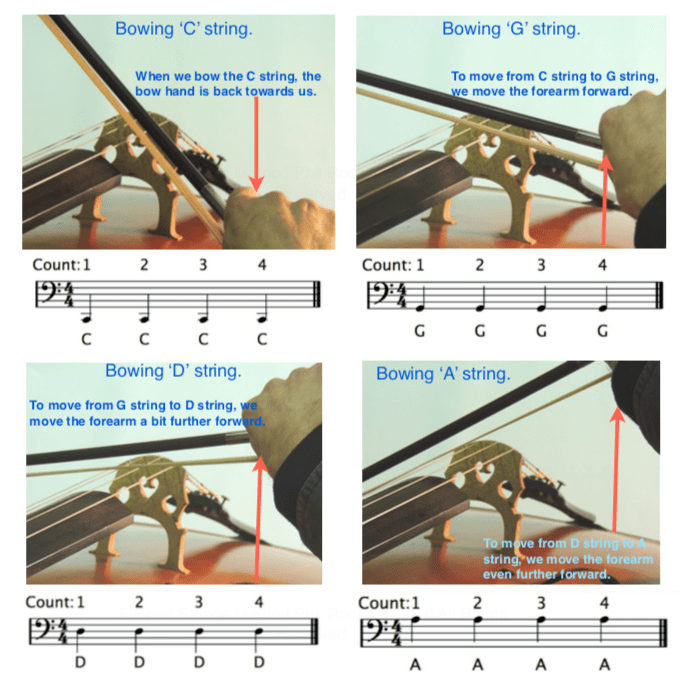
Here is the video from the Flipped Strings Level One iBook – Cello, showing how we bow crotchets on the open strings of the cello.
Click here to return to the menu
1. Writing & Reading Basic Note Values on Open Strings
Click Here to Revise Note Values
Reading and Writing Semibreves or Whole Notes
Reading and Writing Minims or Half Notes
Reading and Writing Crotchets or Quarter Notes
Reading and Writing Quavers or Eighth Notes
Reading and Writing Dotted Minims or Dotted Half Notes
Free Download – Worksheet # 1 Open Strings
Teachers, you can download these free worksheets and print as many copies for your students as you wish.
Click here to return to the menu
2. Writing & Reading Rests
Writing & Reading Rhythms using minim or half note rests
Writing & Reading Rhythms using crotchet or quarter note rests
Writing & Reading Rhythms using quaver or eighth note rests
Writing & Reading Rhythms using a mixture of rests and notes
Free Download – Worksheet # 2 Rests
Teachers, you can download these free worksheets and print as many copies for your students as you wish.
Click here to return to the menu
3. Writing & Reading Rhythm in Different Time Signs
Writing & Reading Rhythms in 4-4 time
Writing & Reading Rhythms in 3-4 time
Writing & Reading Rhythms in 2-4 time
Free Download – Worksheet # 3 Time Signatures
Teachers, you can download these free worksheets and print as many copies for your students as you wish.
Click here to return to the menu
4. Writing & Reading Rhythm – Barlines
Placing Barlines in 4-4 time
Placing Barlines in 3-4 time
Placing Barlines in 2-4 time
Free Download – Worksheet # 4 Barlines
Teachers, you can download these free worksheets and print as many copies for your students as you wish.
Click here to return to the menu
5. Sharps – raising notes a semitone
Using a Sharp to Raise a Note by a semitone
Using Sharps with Crotchets in a 4 – 4 Bar
Click here to return to the menu
6. Writing & Reading Notes Using 1st Finger
Writing & Reading the 1st Finger on C String
Writing & Reading the 1st Finger on G String
Writing & Reading the 1st Finger on D String
Writing & Reading the 1st Finger on A String
Free Download – Worksheet # 6 Using 1st Finger
Teachers, you can download these free worksheets and print as many copies for your students as you wish.
Click here to return to the menu
7. Writing & Reading Notes Using 3rd Finger
Writing & Reading the 3rd Finger on C String
Writing & Reading the 3rd Finger on G String
Writing & Reading the 3rd Finger on D String
Writing & Reading the 3rd Finger on A String
Free Download – Worksheet # 7 Using 3rd Finger
Teachers, you can download these free worksheets and print as many copies for your students as you wish.
Click here to return to the menu
8. Writing & Reading Notes Using 4th Finger
Writing & Reading the 4th Finger on C String
Writing & Reading the 4th Finger on G String
Writing & Reading the 4th Finger on D String
Writing & Reading the 4th Finger on A String
Free Download – Worksheet # 8 Using 4th Finger
Teachers, you can download these free worksheets and print as many copies for your students as you wish.
Click here to return to the menu
9. Writing & Reading D Major Scale & Arpeggio
Writing & Reading D Major Scale
Writing & Reading G Major Arpeggio
Free Download – Worksheet # 9 D Major Scale & Arpeggio
Teachers, you can download these free worksheets and print as many copies for your students as you wish.
 Flipped Music Learning