

This work is licensed under a Creative Commons Attribution 4.0 International License.
Rhythm:
The pattern of long and short notes in music as well as the emphasis of strong as compared to weaker beats against a regular Pulse.
Click or tap on one of the lesson topics below to go to that lesson/section or just scroll down to find the lesson – section you are looking for. If you want to copy any of these lessons into your Google Classroom or other LMS, then just tap or click on that link and copy the URL for that section into your lesson plan. You can also download and print the worksheets as hardcopy for students
This first part of the page is connected directly with the Level 1 Flipped Strings Method books and iBooks If you are learning violin, viola cello or double bass through the Flipped Strings Teaching Method – www.flippedmusic.com.au – then you will find these tutorials in Rhythm & Pulse very helpful. All music teachers and students are welcome to use the resources on this page.
Section 1 – Note Values

The 4 Phils explain note values
When we play notes on a bowed string instrument such as a violin or a cello, we can sustain the note for as long as we are able to move the bow. In the rows of notes below, you can learn to clap and count the note values.
Counting Semibreves

Watch the video below to hear our cellist from the 4 Phils String Quartet explain all about semibreves.
Counting Minims

Watch the video below to hear our viola player from the 4 Phils String Quartet explain all about minims.
Counting Crotchets

Watch the video below to hear our 2nd violinist from the 4 Phils String Quartet explain all about minims.
Counting Quavers & Semiquavers

Watch the video below to hear our 1st violinist from the 4 Phils String Quartet explain all about quavers & semiquavers.
Download, print and complete worksheet 1 – Note Values
Section 2 – Rests
Rests show us where and for how long we have silence in music. Here is a list of the basic rests in music.
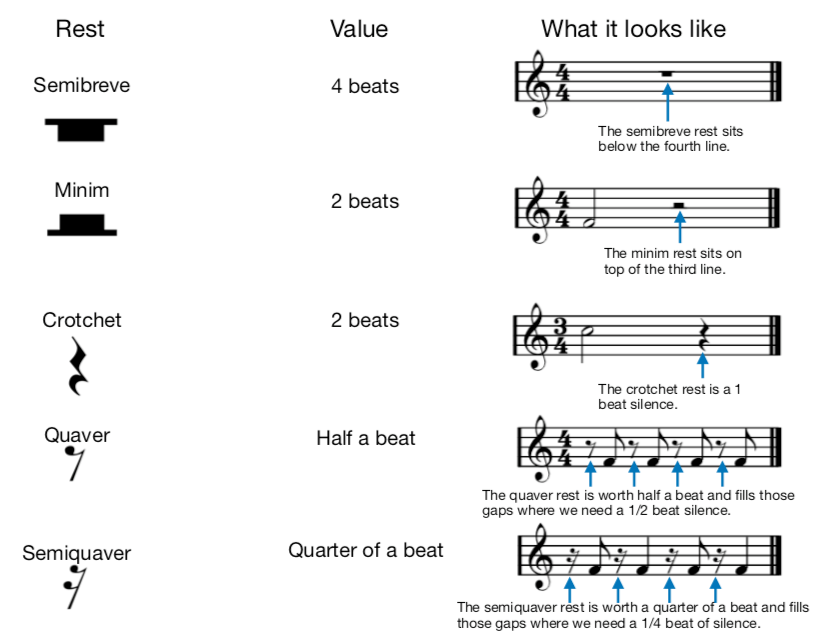
Let’s have a listen to what these rests sound like. What’s that you say? How can we listen to rests? That’s a great question. Each of these 2 bar examples of rests has notes in it and also a crotchet pulse click track. Rests do not make any sense unless they are the exact correct length of silence at the exact right time in the beats of the bar.
Semibreve Rest

All you can hear is the metronome click beat. This demonstrates that when we have whole bars of rests – especially if we are playing with other musicians, then we have to make certain that we count the length of rests.
Minim Rest

You can hear the metronome click and there are 2 clicks in each bar that the notes do not play – these are on beats 3 & 4.
Crotchet Rest

You will notice that the notes play on the 2nd and 4th beats of the bar – with the 2nd & 4th metronome clicks.
Quaver Rest

In the first bar, the quavers fall exactly on the metronome click. In the second bar, you can hear that the quavers fall just after the metronome click. This is because there is just half a beat of silence or rest ON the beat.
Semiquaver Rest

In the first bar, the semiquavers are on the beat, so you can hear them with the metronome click but in the second bar, the notes are falling just after the pulse or beat very quickly because they are only separated by semiquaver rests.
So…. what do we conclude about rests?
It is very important to always count the beat when we are playing or singing. We need to keep in time with the notes that we play BUT….. we also need to count very carefully so that the silences or rests are also exactly the right length.
“The music is not in the notes, but the silence in between”
Wolfgang Amadeus Mozart
Section 3 – What is Rhythm & Pulse?
When we combine these rhythmic values or notes together, we have rhythm.

However, a rhythm is meaningless if it does not have a steady pulse or beat.
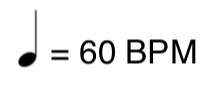
- Pulse – is a steady beat in music; constant and unchanging like a heartbeat or a clock. It can be measured in Beats Per Minute or BPM. For example:
- Rhythm – is the pattern of short and long sounds; and silences (or rests) in a song or piece of music.
Here is an example of a “Pulse” or Beat
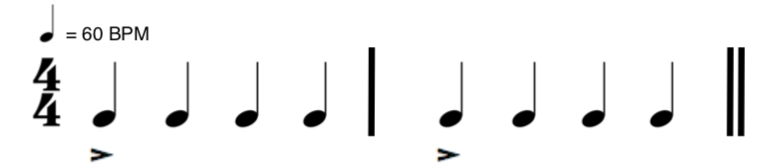
When you clap this pulse, the beats sound even and all exactly the same. However, the sideways arrow on the first beat of each bar (known as an accent) indicates that we would clap or play the first beat of every bar a little stronger. This emphasis gives music a rhythmic feel. If there were 3 beats in the bar, then the emphasis would be on every third beat. More on this later when we learn about Time Signatures.
Rhythm & Pulse Together
This is what it looks like when we combine pulse and rhythm. The bottom row of notes consists of steady unchanging crotchets or quarter notes at a steady unchanging pulse.
The top row is a mixture of short and long notes. However, you can see how the rhythm aligns with and plays at the same time or pulse as the bottom row. Try clapping or stomping the bottom row and have a friend clap the rhythm – then swap.
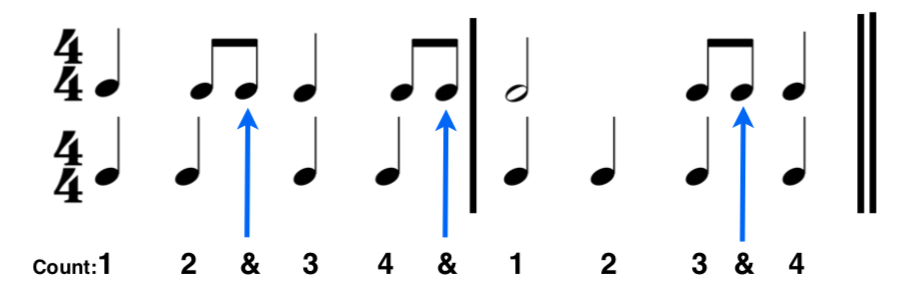
Click on the play button to hear the rhythm on snare drum with the pulse on bass drum
Count 4 beats as you tap or clap the beat/pulse and rhythm. When you clap the rhythm, say “and” (&) on the quaver beat as indicated.
Here is an excerpt (a short section) from Eine Kleine Nachtmusik by Mozart. This is just the melody being played by the 1st violin and the bass line being played by the cello. You can see how the melody line has a complex rhythm consisting of long and short notes whilst the cello is playing a steady quaver Pulse.
Listen to the 4 Phils explain about Rhythm & Pulse.
Download, print and complete worksheet 2 – Rhythm & Pulse
Section 4 – All About Bar lines
In music, rhythm is organised into bars or measures. The music is divided into bars or measures with bar lines. Here is what rhythm looks like when there are no bar lines.
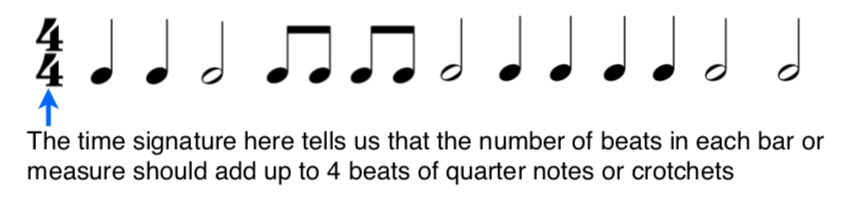

Here is what a rhythm with 3 beats in a bar looks like without barlines.

And now with barlines place to give us 3 beats in each bar.

Section 5 – Time Signatures
Time signatures simply tell us how many beats we need to count in each bar and what sort of notes/beats we are counting. It helps to have a look at the American note names. We use the term crotchet, quaver, minim etc but the American note names start with the semibreve as a “whole note”. See below.
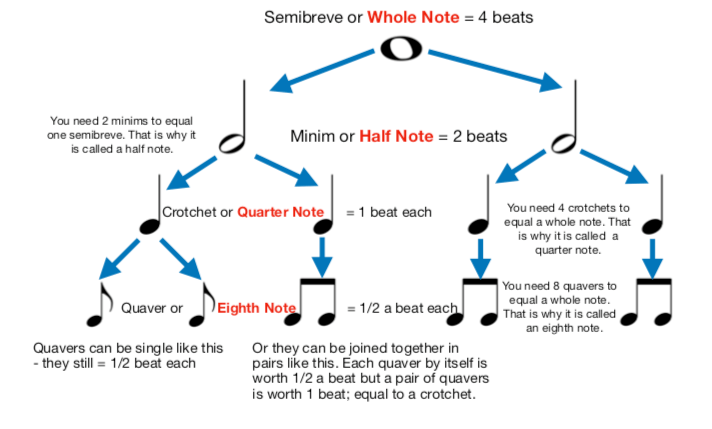
The above information helps us to understand how time signatures work. The top number tells us how many beats are in each bar. The bottom number tells us what sort of notes/beats we are counting.
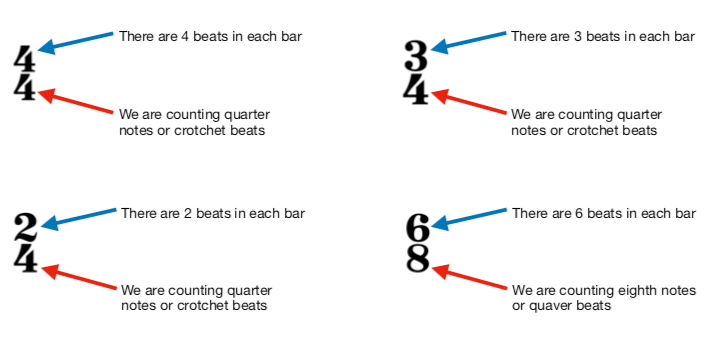
Here is what a 4-4 pulse looks and sounds like
Click on the play button below to listen.
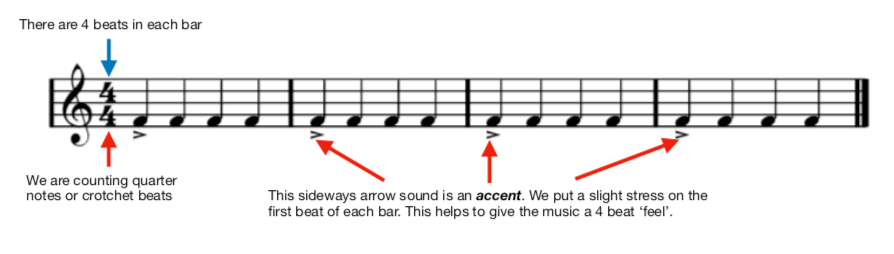
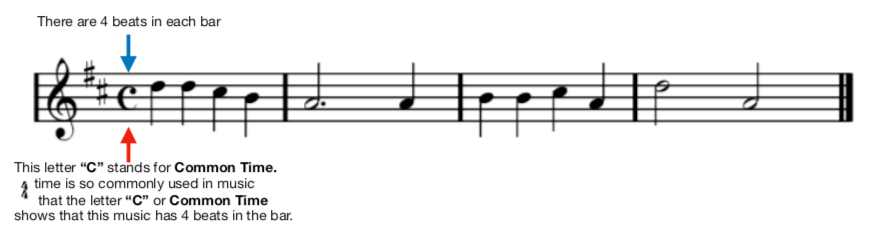
Here are the first 4 bars of Rigadoon by Henry Purcell. It is in 4-4 time. Listen to how the violin puts an emphasis on the first beat of each bar. Click on the play button below to listen.
Here is the full conductors score for the published arrangement for school string orchestra (Grade 2) – which can be preview and purchased at our Flipped String Ensembles Page. With the digital download, you receive a zipped folder with all parts – the students’ parts all have QR codes so that students can scan one code to listen to just their part and then another QR code to read the full score and hear all the parts together. Click on the download button below to download free samples of the Violin 1 and Violin 2 parts – these can be played as a duet.
Click here to download a free sample of the violin 1 part for Rigadoon.
Click here to download a free sample of the violin 2 part for Rigadoon.
If there are two of you that play violin, you can play it as a duet.
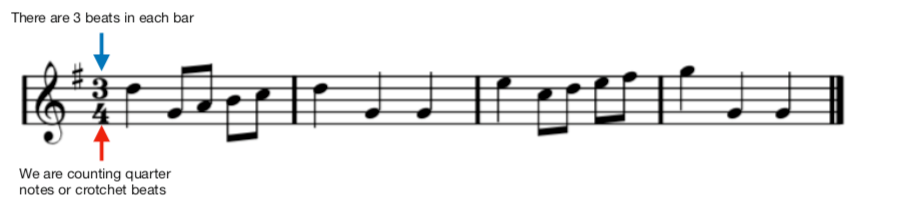
Here is what a 3-4 pulse looks and sounds like
Click on the play button below to listen.

Here is a Minuet by J.S. Bach. Listen to it being played on the violin and notice the emphasis on the first beat of each bar. Click the play button below to listen.
Here is what a 2-4 pulse looks and sounds like
Click the play button below to listen

Here is a simple song in 2-4 time – Yankee Doodle. Click on the play button below to listen.

Here is what a 6-8 or Compound Duple pulse looks and sounds like
Click the play button below to listen.
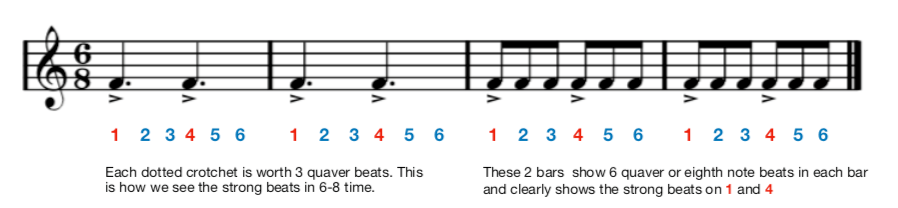
The 6-8 time signature has 6 quavers in each bar but what is important is that the beats are divided into 2 lots of 3 quavers. So the emphasis is on the FIRST quaver beat and the FOURTH quaver beat in each bar. The other name for 6-8 time is Compound Duple because it is divided into 2 x 3 quaver beats.
Here is an excerpt from a famous piece of music in 6-8 time by the composer Bedrich Smetana – Themes from the Moldau. Click the play button below to listen.

Here is the full conductors score from our Flipped Ensemble Pack Arrangement of Themes from the Moldau by Bedrock Smetana. Click on this link to preview and purchase the digital download Flipped Strings Ensemble Pack for Themes from the Moldau for school string orchestra (Grade 5)
Click on the download link below to download a free sample of the violin 1 part to see how the students can read and hear JUST their part and then the conductors score.
Notice how the composer changes the time signature from 6-8 to 2-4 time and then back again – here is the 2-4 melody played by the 1st violin – click on the play button below to listen.

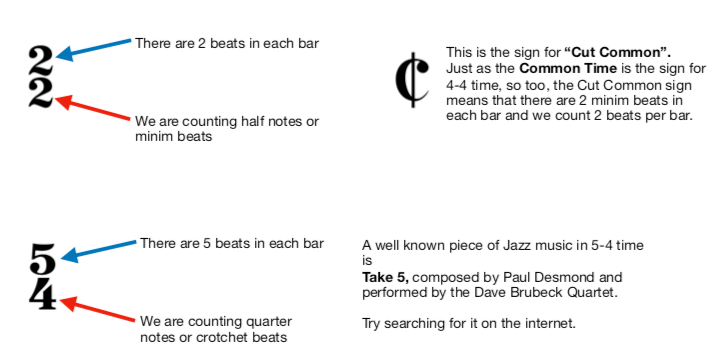
There are more time signatures as shown below – you can research and find more music in these time signatures.
Section 6 – Ties – making notes longer
A tie is a curved line over 2 notes of the same pitch. This increases the length of the note by adding the values of the two notes together.

Here are 2 separate notes – they would be played as 2 separate notes.

Here, these 2 notes are joined together and played as one note worth 5 beats. The reason that we join these 2 notes together is when we want to hold a note across the barline – i.e. for longer than the maximum number of beats in the bar – in this case, for longer than 4 beats. What does this look like in a piece of music?
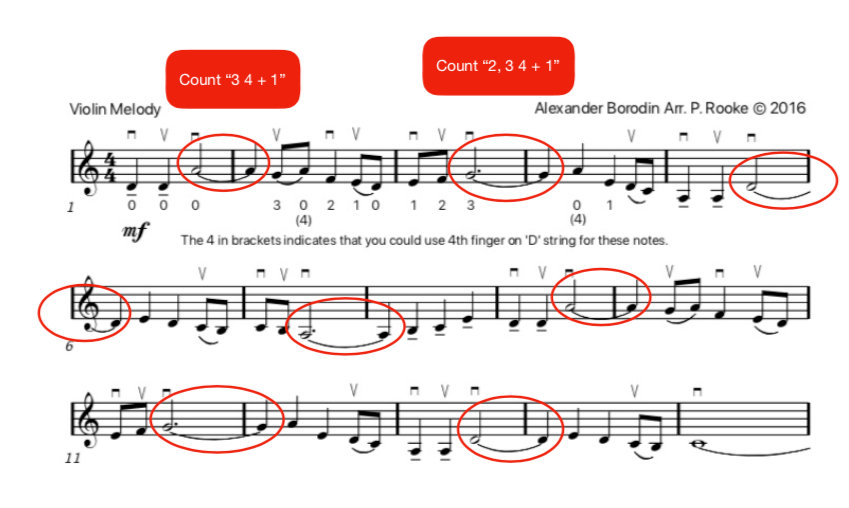
Watch the video of this excerpt to see how these notes are tied across the barline.
Section 7 – Anacrusis or Upbeat
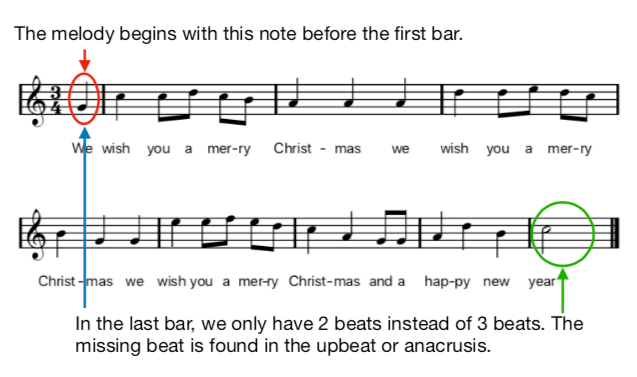
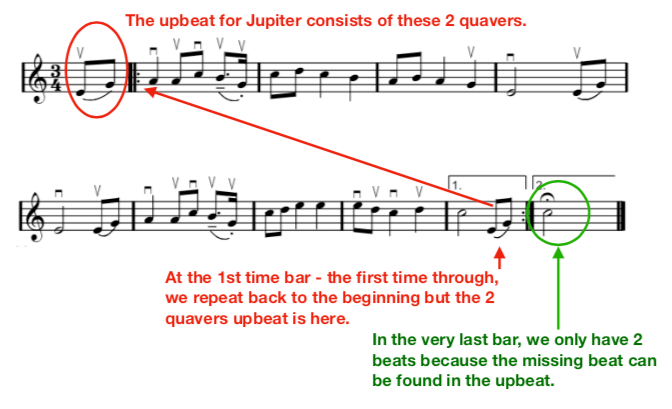
Some pieces of music start with an anacrusis or “upbeat”. This consists of a weaker beat before the first barline. This can be just a single crotchet such as we see in “Now Thank We All Our God” or it can be 2 or more quavers such as in “Jupiter from the Planets”.
Example 1: We wish you a Merry Christmas
Click on the play button to listen
Now Thank We All Our God
The well known hymn; “Now Thank We All Our God” begins with an anacrusis or upbeat.

Now Thank We All Our God can be found in our Flipped Strings Level 2 series
Watch the video to hear how the hymn starts with an upbeat.
Jupiter from the Planets
Jupiter from the Planets begins with an anacrusis or upbeat of 2 quavers or eighth notes.
 Flipped Music Learning