


This work is licensed under a Creative Commons Attribution 4.0 International License.
Teachers:
Click or tap on one of the lesson topics below to go to that lesson/section or just scroll down to find the lesson – section you are looking for. If you want to copy any of these lessons into your Google Classroom or other LMS, then just tap or click on that link and copy the URL for that section into your lesson plan. You can also download and print the worksheets as hardcopy for students and they can scan the QR code with their phone or device on the worksheet to take them to that section/lesson.
Introduction to Noteflight
You can setup a FREE account at noteflight.com and do all of the activities and compose your own music in this very useful online music app. Watch the tutorial video to create and save your first score in Noteflight.
Section 1 – Notes in the Treble Clef
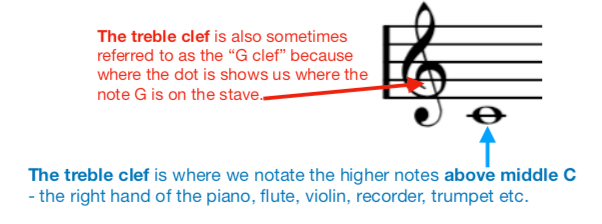
These are the notes written on the LINES of the treble clef.

The notes that sit on the lines of the treble clef can easily be remembered by this sentence – each word starts with the letter of the note on that line.
These are the notes on the SPACES (between the lines) of the treble clef

Section 2 – Notes in the Bass Clef
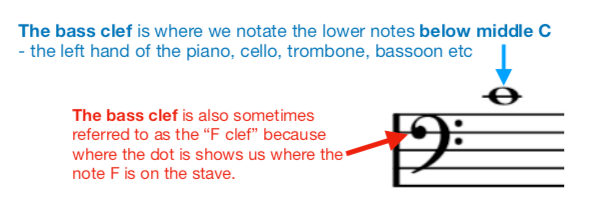
In this section, we will identify the notes in the bass clef and be able to write and read music in the bass clef.
Lines in the Bass Clef
These are the notes on the lines of the bass clef. The sentence “Good Boys Drive Ferraris Always” helps us to remember the notes. Click the play button below the music to hear the notes.

Spaces in the Bass Clef
These are the notes on the spaces in the bass clef. The sentence “All Cows Eat Grass” help us to remember these note names. The low ‘F’ sits below the bottom line of the stave and the higher ‘B’ sits above the top note of the stave. Click the play button below to hear these notes.

Section 3 – Leger Lines
To best understand how leger lines work – why we need them, we need to have a look at the Grand Staff. The Grand Staff is the bass stave and the treble stave joined together.
Below, you see the grand Staff with the line in the middle where Middle C sits. The next picture below is with that middle line removed and there is just a short line through middle C. This best illustrates how leger lines work. If you need to add notes above the stave or below the stave.

Click on the sound file below to hear these notes on the lines of the bass and treble clef
Leger lines allow us to continue to notate and play notes that go above the top line of the stave or below the bottom line of the stave – in the bass or treble clef. Think of leger lines as further extending the stave higher or lower in pitch.

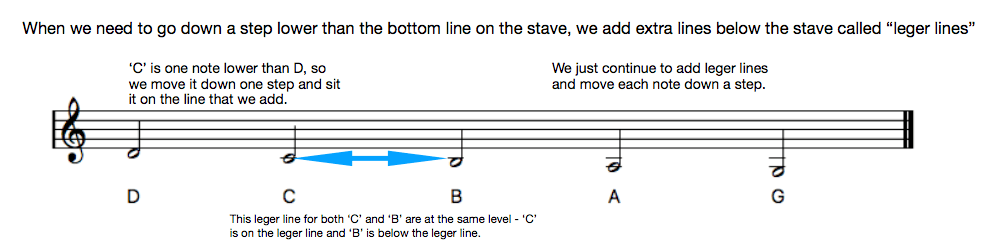

Click the play button to hear these notes
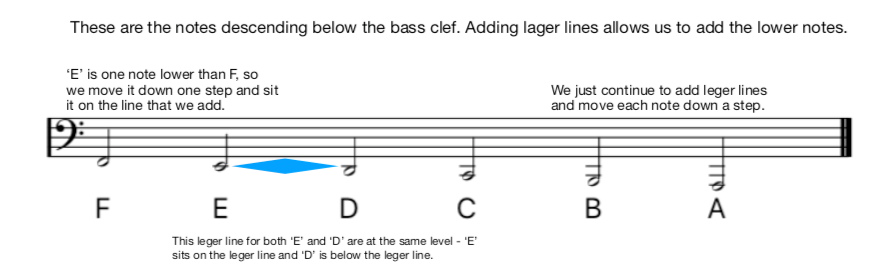
Click the play button to hear these notes
Section 4 -Intervals in C Major
An interval is the musical jump from one note to another. When we measure an interval, we need to make certain that we count the note we start on. In all of the examples below, the starting note is middle C, so we start counting from C to the note above.
When the notes are on top of each other, (as below) both notes are played at the same time.

Click on the play button to hear the intervals being played together
In these examples below, we can hear each example with the notes played separately then together. Don’t forget, when we count the interval – or musical gap between notes, we start counting from the bottom note.
Click the play button below each example to listen.

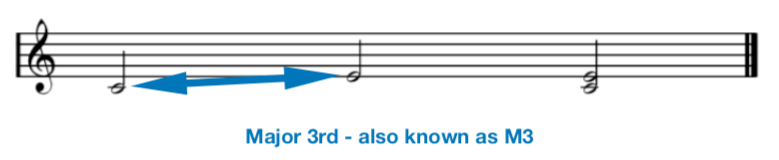

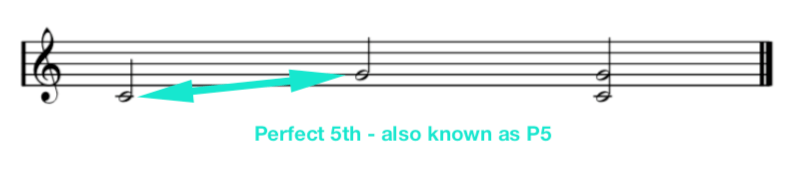


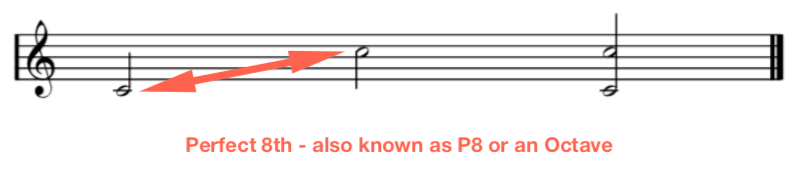
Now………. watch the video of these intervals being played on the keyboard
Section 5 – Tones and Semitones
Patterns of tones and semitones is how music is made up. If we look at the C Major Scale – or any major scale – we can see that some notes are right next to each other without a note between them. These notes right next door are called “SEMITONEs” or half steps. When there is another note between them – as shown below, then this is a TONE – or whole step.
Semitones

Tones

Click on the play button below each example to hear if it is a tone or semitone.
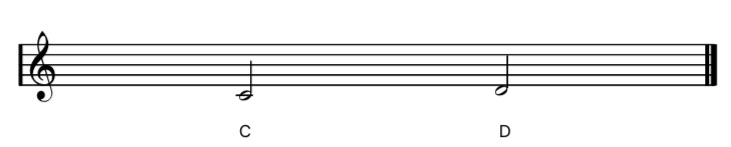
C to D is a tone or a whole step

D to E is a tone or a whole step

E to F is a semitone or a half step

F to G is a tone or a whole step

G to A is a tone or a whole step

A to B is a tone or a whole step

B to C is a semitone or a half step
Section 6 – C Major Scale
What is a scale? A scale is a sequence of notes – either ascending (going up) or descending (going down) by one note steps.
Here is C Major scale ascending (going up) in the treble clef starting on middle C. The scale degree numbers are marked underneath the note names in blue.

Click on the play button to hear the C Major Scale ascending
Note the patterns of tones and semitones – refer back to the previous section on intervals, tones & semitones. All major scales are made up of this pattern of tones and semitones – note that the semitones (half steps) are always between the 3rd & 4th and the 7th & 8th notes of the scale.
Here is C Major scale in the treble clef descending (going down)
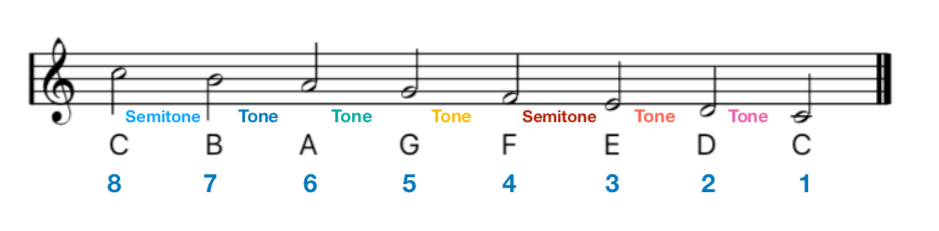
Click n the play button below to hear the C Major Scale descending (going down) in the treble clef.
Here is the C Major scale in the bass clef ascending. (going up) Note that it sounds lower because it is in the octave below middle C. Remember that the bass clef indicates the notes below middle C.

Click on the play button below to hear the C Major scale ascending (going up) in the bass clef.
Here is the C Major scale descending (going down) in the bass clef. The starting note is Middle C and it goes down an octave to low C.

Note that the order of tones and semitones are in reverse – the semitones in a major scale are always between the 3rd & 4th and the 7th & 8th notes. Click the play button below to listen.
In a later section, we will look at minor scales as well – which sound different to major scales because they have a different pattern of tones and semitones.
Section 7 – C Major Arpeggio
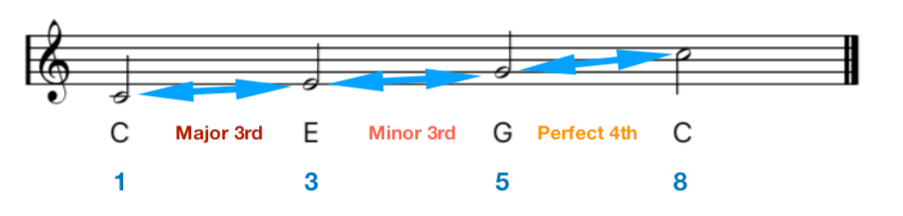
What is an arpeggio: An arpeggio is built on the 1st, 3rd, 5th and 8th notes of the scale. Another way to think about an arpeggio is if you only play those notes from the scale, it looks and sounds like the arpeggio below. The scale degree numbers are marked to show the notes from the scale.
The intervals or jumps between the notes are each a bit different. The first jump from C to E is a Major 3rd, the next jump from E to G is a minor 3rd (slightly smaller) and the last jump from G to C is a perfect 4th. Refer back to the section on intervals to understand about intervals or the distance between notes. Click on the play button below to hear the arpeggio.
Watch the video to see C Major Arpeggio played on the keyboard
An arpeggio can be ascending – going up, or descending – going down. Here is C Major descending in the treble clef.

Click on the play button below to listen
Here is the C Major Arpeggio in the bass clef ascending – the intervals or jumps between notes are exactly the same is the C Major Arpeggio ascending – but this one is an octave (or 8 notes) lower.
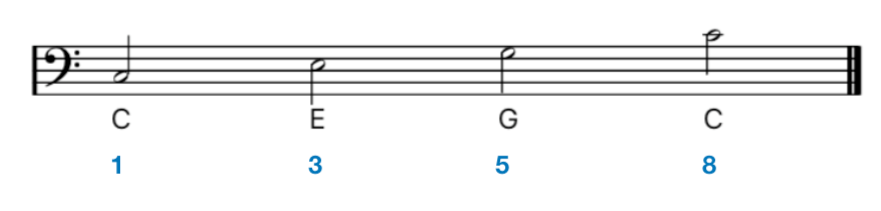
Click on the play button below to listen
Here is the C Major arpeggio in the bass clef descending – starting on Middle C in the bass clef and going down.
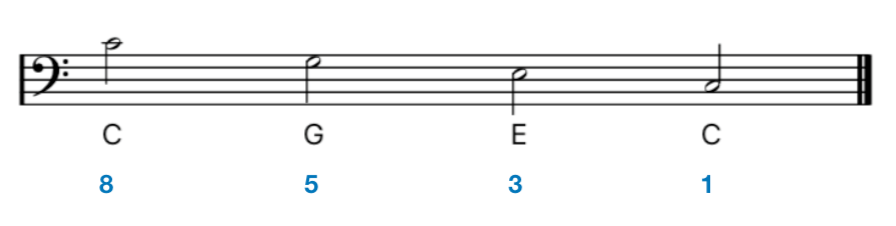
Click on the play button below to listen
Section 8 – The Shape of Melodies
Now that we have learned about intervals – musical jumps, scales and arpeggios, tones & semitones, we can put all that together to make a melody. A melody (or tune) can be made up of steps, (a jump of one note at a time) or leaps. In other words, a combination of scales and arpeggios.
The first melody we will have a look at uses mainly steps – some leaps, but mainly in steps.
Ode to Joy
Watch the video of Ode to Joy being played on the piano. NOTE: this is being played with the right hand ABOVE middle C in the treble clef.
Click on “Download” to download the sheet music for Ode to Joy in the treble clef – you can play this on any treble clef instrument – eg recorder, violin, flute or guitar.
Click on “Download” to download the sheet music for Ode to Joy in the bass clef – you can play this on any bass clef instrument – eg cello, trombone – left hand piano
Here is the first line of Ode to Joy – showing mainly step motion – tones and semitones – refer back to Section 5 -Tones & Semitones
Ode to Joy – 1st line

Click the play button below to hear the first line of Ode to Joy
Kumbaya
Watch the video of Kumbaya being played on the piano. NOTE: this is being played with the right hand ABOVE middle C in the treble clef.
As opposed to “Ode to Joy”, which is built mainly on steps, Kumbaya starts with the first 3 notes of the C Major Arpeggio.
Click on “Download” to download the sheet music for Kumbaya in the treble clef – you can play this on any treble clef instrument – eg recorder, violin, flute or guitar.
Click on “Download” to download the sheet music for Kumbaya in the bass clef – you can play this on any bass clef instrument – eg cello, trombone – left hand piano
Here is just the first 8 bars of Kumbaya. As indicated, the melody and main theme of the melody is the first 3 notes of the C Major Arpeggio.

Click the play button below to hear the first 8 bars of Kumbaya.
Section 9 – Compose a Simple Pentatonic Melody
A pentatonic melody is composed with the pentatonic scale consisting of just 5 notes – It does seem that there are 6 notes here, but the starting note is ‘E’ on the bottom line and the top note is ‘E’ on the top space.

Watch the video of how to compose a pentatonic melody in Noteflight – go to the section on Introduction to Noteflight to learn how to create a Noteflight account if you would like to use free notation software to create your pentatonic melody.
Here is the melody we composed in Noteflight in the video above.

Click the play button below to listen
You can download this worksheet and compose a pentatonic melody just by writing it on the sheet. Teachers – you can download and print as many copies of the worksheet as you wish and hand out to your students. The students can access the instructional video and backing track via a QR code on the worksheet.
Watch the video on how to compose your pentatonic melody on the worksheet then you can play it on your instrument with the backing track below.
Try to play your composition with the backing track below – there are 4 clicks before you start.
Phil # 3 shows us how to compose and play your melody on a very inexpensive recorder. You don’t need to spend a lot of money to start composing and playing your own music
Section 10 – What is a Motif?
Let’s have a look at how we might start composing a melody with a Motif.
What is a motif? A motif is a short melodic idea. (though it is also possible to have just a rhythmic motif as well) Here are two short melodic motifs composed by one of the most famous Classical composers – Wolfgang Amadeus Mozart.
Sonata in C – 1st movement: See how Mozart constructs these first 2 bars to make a Motif or short musical idea.
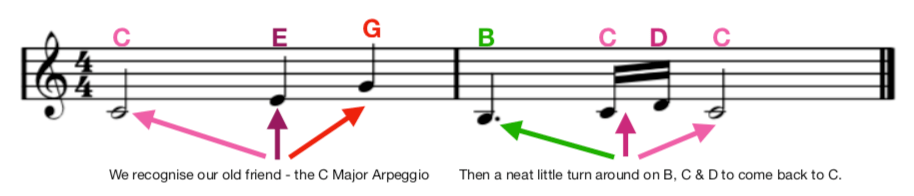
Click on the play button to hear the motif and if you have a keyboard, you could try playing it.
Watch the video below by Youtube artist “Rousseau” The whole 1st movement is just over 5 minutes but well worth listening right through to see how Mozart develops this very simple motif.
Click here to Subscribe to his channel to hear more performances of classical piano pieces.
The 2nd motif that Mozart uses to start off a larger composition is the famous Twinkle Twinkle Little Star. Have a look at just how simply he starts this melody with this short motif. In actual fact, Mozart “borrowed” this from a French folk song “Ah! vous dirai-je, maman.” Baa Baa Black Sheep is also based on this melody.

Click on the play button below to hear this simple motif
Mozart developed this simple theme into 12 variations for piano – this shows how a very clever composer can take a simple theme and change it in various ways – again, this performance is by Youtube artist “Rousseau”. Listen to the full 12 variations here by Rousseau.
Section 11 – Developing a motif into a melody
Here is a very simple motif that I composed – it starts with a leap downwards of a 4th from the top C to G, then a little turn around.

Click on the play button to hear it.
Have a look and listen to how I develop this into an 8 bar melody.

Download and print the worksheet to develop this motif into a melody.
Using Noteflight to compose and develop a motif & melody – Follow this tutorial video and you can compose your own motif and develop your motif in Noteflight.
Section 12 – Accidentals
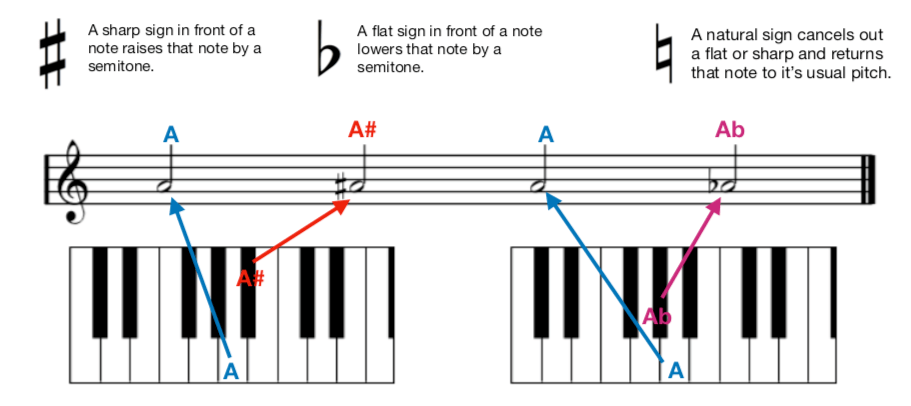
Using Accidentals to Make Semitones
Each of these pairs of notes or intervals is a semitone or half step apart. Note that ‘E’ & ‘F’ are already a semitone apart – as we learned in the section on “Tones & Semitones”, there is no black note between ‘E’ & ‘F’ and ‘B’ & ‘C’.

C Chromatic Scale
A chromatic scale is one where every step is a semitone, If you want to play a chromatic scale on the piano keyboard, then you simply play from the starting note every single white and black note – from one note to the very next note.
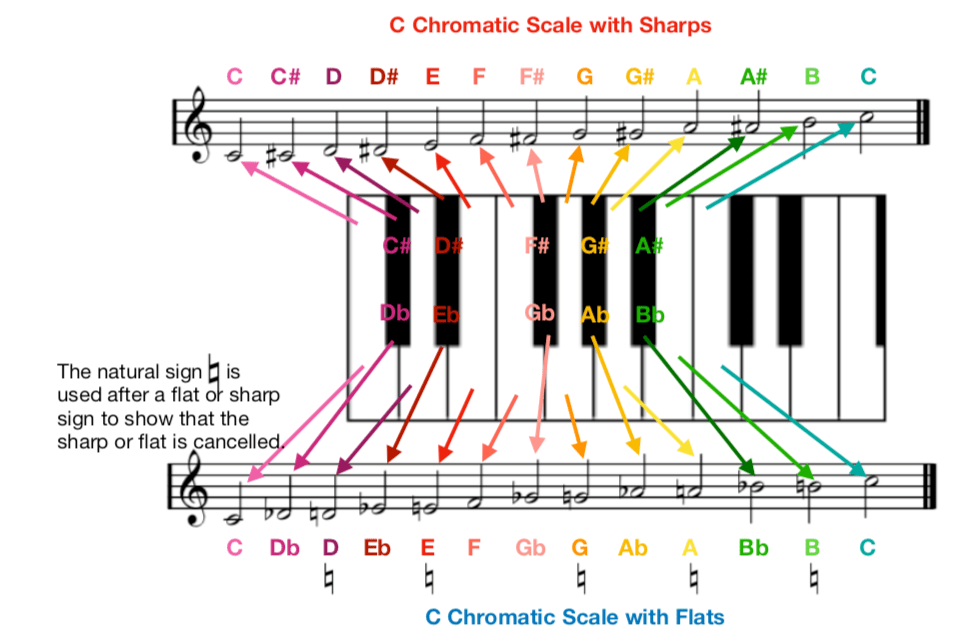
Click on the play button below to listen. Both the scales above sound exactly the same – see the next section about “Enharmonics” to find out why.
Enharmonic Notes
The word “Enharmonic” means that notes that might appear different have the same pitch. For example – if we go up a semitone from F to F# – or down a semitone from G to Gb, then this is the exact same black note that is between F and G on the piano keyboard – F# and Gb are the same note. G# and Ab are the same note etc.

Click on the play button below to listen – note how each pair of notes sounds at the same pitch.
D Major Scale With Sharps
Here is the D Major scale BUT, it’s not quit correct. Click on the play button below to have a listen. The notes and scale degree numbers are listed below.

BUT…. Look at the patterns of tones and semitones and check with the previous section on C Major Scale to see the patterns of tones and semitones.
This is not a major scale because it would need to have the semitones between 3 & 4, 7 & 8 – or in this scale, F & G and C & D. How can we fix this? See below for the solution.

By making the F and the C sharp – moving them up a semitone, that changes the pattern of tones and semitones so that it is now a correct major scale. click on the play button below to hear the correct version with F# and C#.
Adding Accidentals in Noteflight
Watch this tutorial video to see how you can change notes to flats and sharps in Noteflight
 Flipped Music Learning