

Harmony:
The sounding of two or more notes played or sung at the same time so as to make a pleasing sound. The study of harmony involves chords and their construction and how they combine in chord progressions.
On this page about chords and harmony, we learn first of all about basic chords and learn how to play chords on piano and guitar – leading to the construction and playing of chord progressions – even how to arrange a chord progression for string quartet.
We also learn about key signatures for Major Keys, Minor Keys, the cycle of 5ths and modulation – or how a piece of music can change key.
Click or tap on one of the lesson topics below to go to that lesson/section or just scroll down to find the lesson – section you are looking for. If you want to copy any of these lessons into your Google Classroom or other LMS, then just tap or click on that link and copy the URL for that section into your lesson plan. You can also download and print the worksheets as hardcopy for students.
Noteflight – Some of the tutorial videos here use Noteflight which is a free online music notation app – you can create you own Noteflight account here You can then use Noteflight to arrange and compose your own music.
1. Basic Chords – Major Minor Diminished
Chords are notes sounded together. In other words, instead of playing one note after another, (as in C Major Scale – click here to see the pattern for C Major scale) with chords, we play all the notes at the same time.
When there are just THREE notes in a chord, then we might also call it a triad.
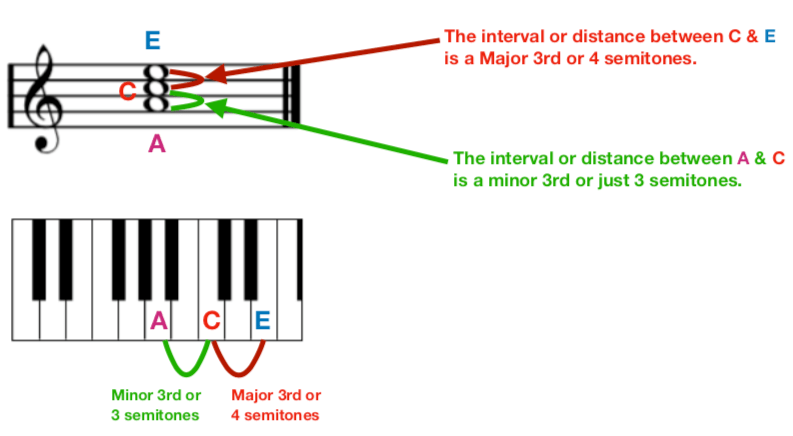
This is C Major Chord or C Major Triad. The notes are C – E – G. With a Major triad, the interval between the bottom note and the middle note is the larger interval – a Major 3rd. The middle note and the top note is a smaller interval of minor 3rd.
Some people say that the Major chord has a “happy” sound.

This is the A minor chord or triad. ‘A’ is the bottom note, ‘C’ is the middle note and ‘E’ sits on top. The minor chord or triad differs from the major chord or triad in that the interval or distance between the bottom note and middle note is the smaller interval – a minor 3rd. The interval between the middle note and the top note is the larger interval – a Major 3rd.
Some people say that the minor chord has a “sad” sound.
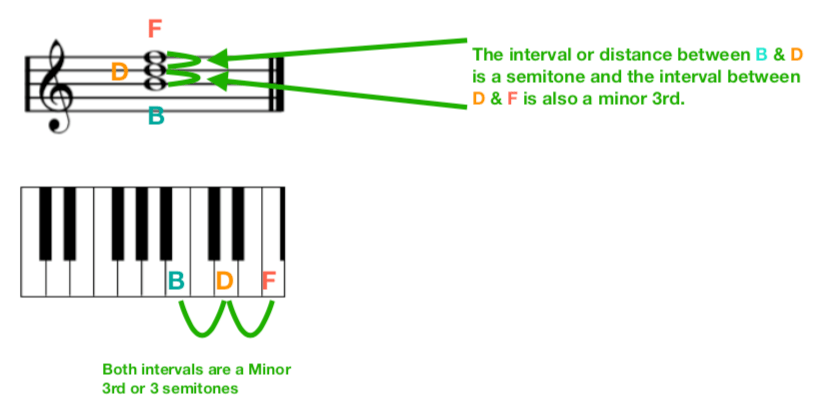
This is the B diminished chord or triad. A diminished chord sounds and looks different to Major or minor chords. The interval between both the bottom note and the middle note is minor 3rd. The interval or distance between the middle note and the top note is also a minor 3rd. It has a harsh, tense kind of sound.
Simple Chords on C Major Scale
These are the chords that are built on the C Major Scale (Click here to learn about the C Major Scale) All of these chords consist of JUST the white notes on the piano. If a chord has JUST the letter name, then it is a Major chord.

Watch this video to see how to construct simple C Major Chords in Noteflight
2. Chord Inversions
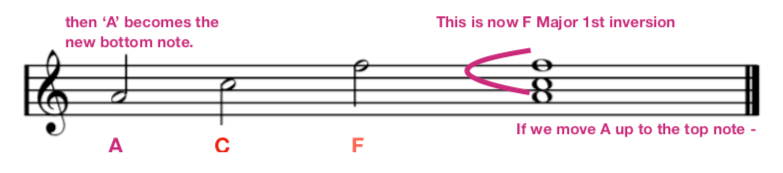
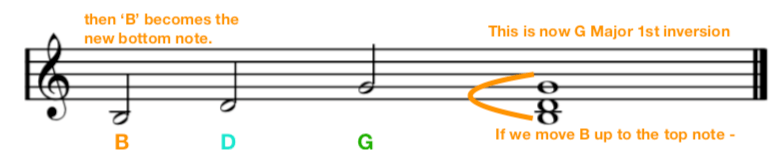
The chords in the previous section are what we call Root Position Chords. In this section we look at the root position chords of C Major, F Major and G Major and also the 1st and 2nd inversions. A chord inversion is when we take the bottom note and move it to the top of the chord. The reason we do this is to make a smoother musical arrangement and also to make it easier to play a chord progression on the piano – so the chords move smoothly from on chord to the next.
C Major – root position – 1st & 2nd inversion


F Major – root position – 1st & 2nd inversion




G Major – root position – 1st & 2nd inversion




Watch this video to see these chords and inversions being played on the piano
Watch this video to see how to construct chord inversions in Noteflight
3. Chords on Piano
Once we know how to play some basic chords in C Major and we understand root position and inversions, we can play simple chord progressions. Here is a simple chord progression in C Major.
Here is the basic C Major Chord progression using root position chords in the right hand.

Here is the simple chord progression made up of those chords. Instead of the right hand just playing root position chords, we play these inversions so that it is easier to place the hand and it sounds smoother.

4. Chords on Guitar
Here are just the basic chords for C Major on Guitar – if you are learning a song in C Major, these are the chords you will most commonly find.



Watch this video to see how to play and change these chords – practise slowly
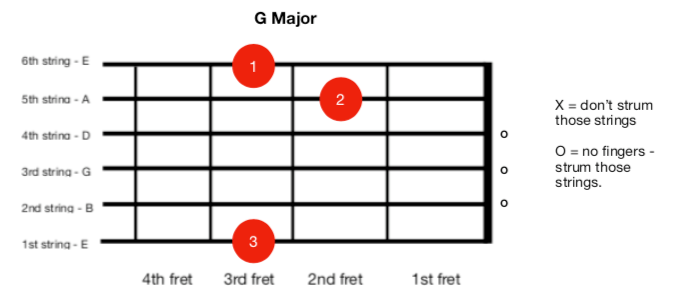
Here are the simple set of chords that you will find if you are learning a song in G Major – songs in G Major will commonly use these chords. Some chords are used in both C Major and G Major, so you will already know some of them.


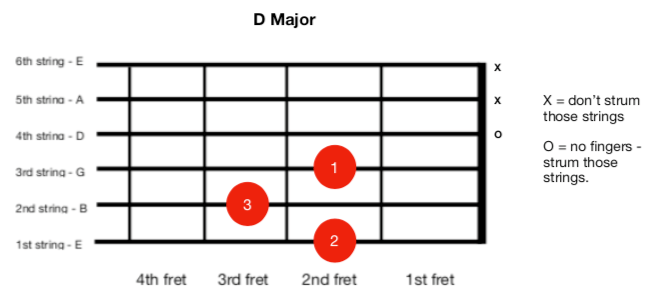
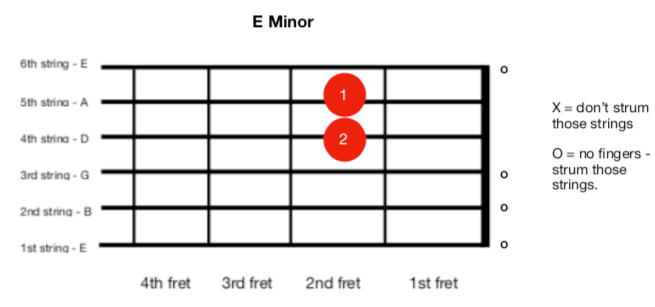
Watch this video to see how to play these chords and how to change between chords – practise slowly
5. Chord Progressions
What is a Chord Progression?
In these following sections, we will learn how to play a chord progression on piano, guitar and even how to score this G Major chord progression for a string quartet. But first – we need to understand what a chord progression is. How do we write a chord progression and how do we play it? And then….. what is it for?
In music, a “chord progression” or “harmonic progression” is a succession or sequence of chords that provide the structure for a song or piece of music and establish the key or tonality of the piece/song.

Here is the chord progression in G Major – it goes for 12 bars but note that the last 4 bars is the same as the 1st 2 bars. Click the play button below to listen.
Watch this video to see how to construct this G Major Chord Progression in Noteflight
6. Playing a chord progression on piano
We can play the G Major Chord progression on piano as above with just the right hand and then adding the left hand playing the bass-line as well.

Watch the video below to see how to play this chord progression on piano – first just the right hand and then with 2 hands.
Next, we could play a dotted rhythm in the right hand to make it more interesting

Watch the video below to see how to play this dotted rhythm
Then we could play the chords in alternating (arpeggio) quavers in the right hand.
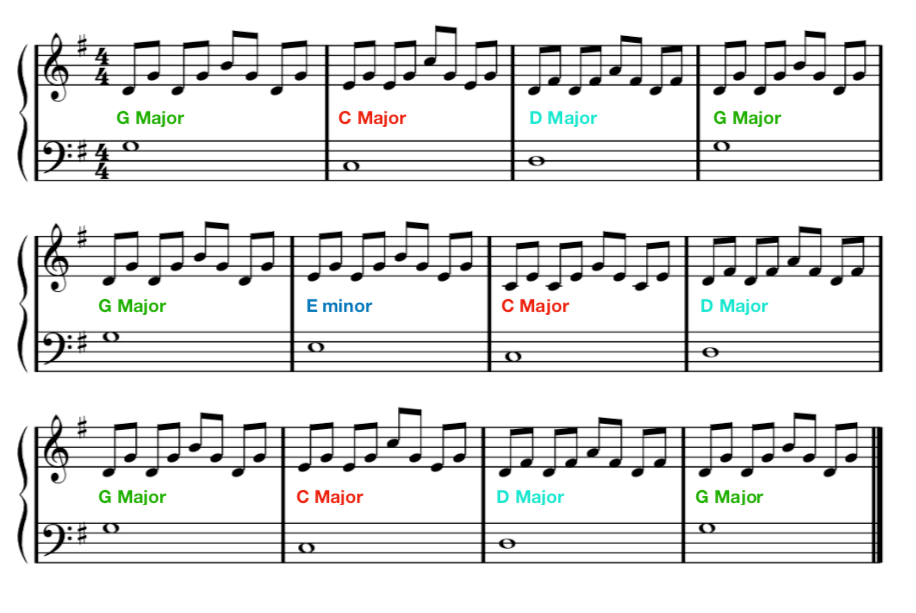
Watch the video below to see how to play the right hand arpeggio quavers on the piano.
7. Playing a Chord Progression on Guitar
Playing this G Major chord progression on guitar is very simple – you can learn to play the chords in the previous section 4. Playing Chords on Guitar.
Here are the basic chords again.

Watch the video below to play the guitar chords with a plain strumming pattern
Watch this video to see how we can play the same chord progression but with a finger picking pattern.
8. Arranging a chord progression for string quartet
The 4 Phils show us how
If we have a chord progression written out for piano, that is easy for a pianist to read. If the chord symbols are written above, then that is easy for a guitarist to play the chords. But what if you want to write your chord progression to be played by a string ensemble or quartet? If you have a string group or quartet in your school, then here is how you can write music for them.
Watch the demonstration by our own string quartet – The 4 Phils.
Chords for String Quartet – Semibreves
Here is how we write and play the basic chord progression for string quartet


And here are the 4 Phils playing the basic arrangement
Watch this video to see how to this chord progression for string quartet in Noteflight
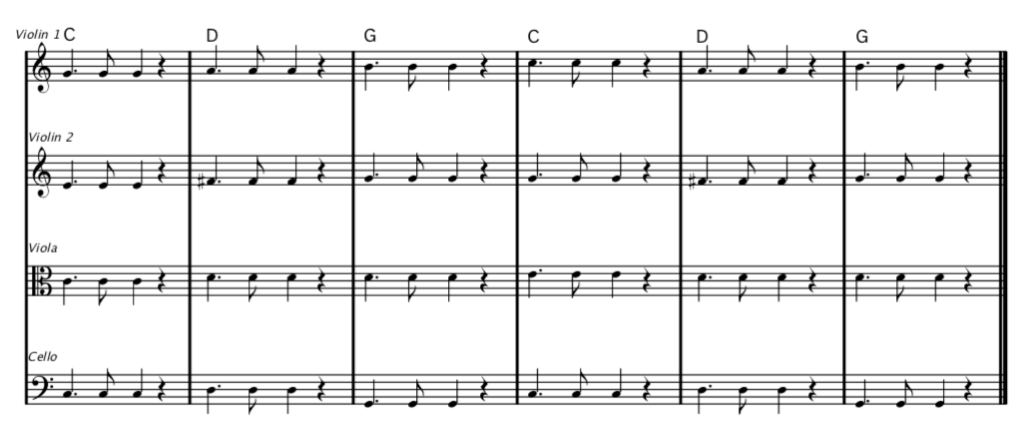
Chords for String Quartet – dotted rhythm
Here is the G Major chord progression for string quartet written with a dotted rhythm.

And here are the 4 Phils playing it for us.
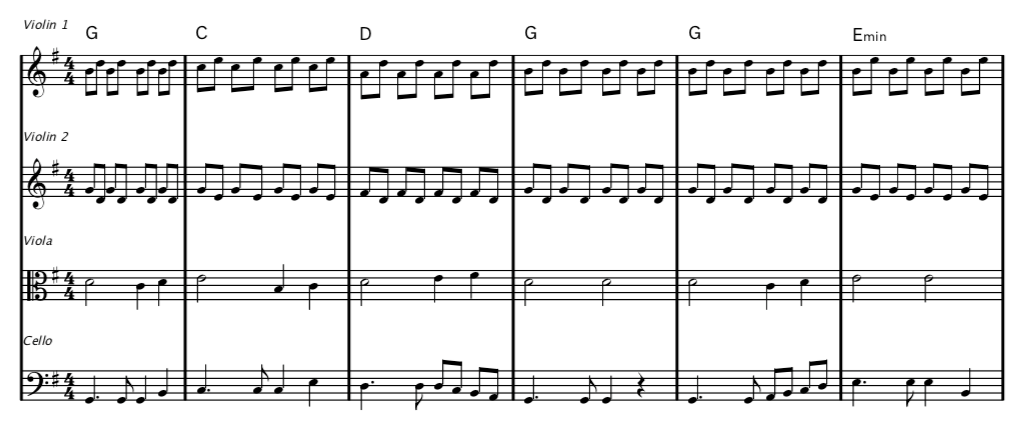
Chords for String Quartet – an arrangement with quavers and melody
Here is an arrangement of the G Major chord progression with the violins outlining the chords in quavers, the viola playing a simple melody and the cello playing a bass line with passing notes.

And the 4 Phils string quartet playing it for us.
9. Major key signs and the cycle of 5ths
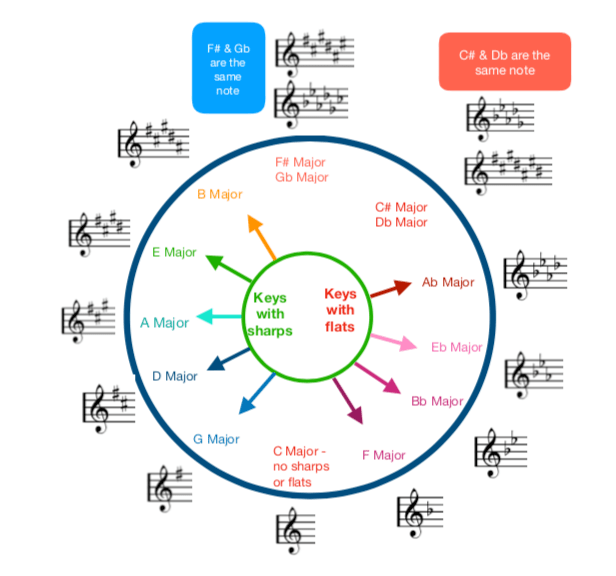
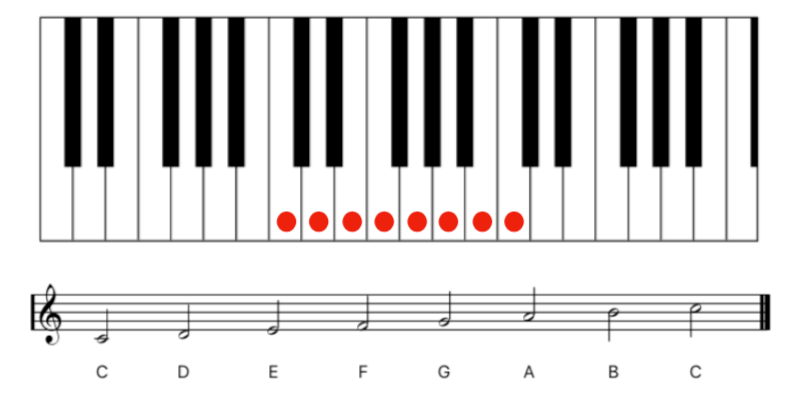
The cycle of 5ths shows us how to find the key signature for all the Major Keys – follow the circle around clockwise from C Major at the bottom – up 5 steps each time and this will indicate the key sign for that key. Click here to see the pattern of tones and semitones in C Major Scale.
Order of Sharps in Key Signs

Order of Flats in Key Signs
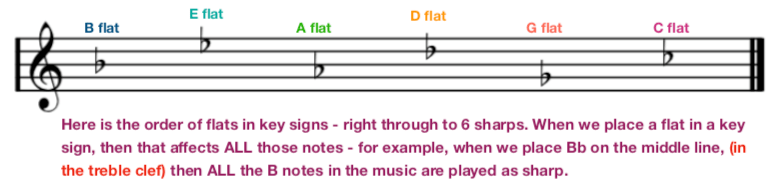
We will just show C Major and the Major Keys up to 4 sharps and 4 flats. These are the most commonly used Major keys.
Click here to go to our page about Accidentals to understand how flats & sharps work.
C Major – no sharps or flats
Major Keys with Sharps
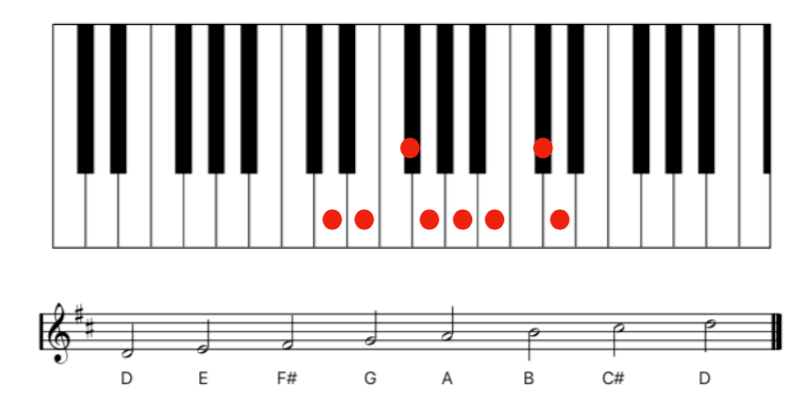
G Major – 1 sharp – F

D Major – 2 sharps – F & C
A Major – 3 sharps – F, C & G

E Major – 4 sharps – F, C, G & D

Major Keys with Flats
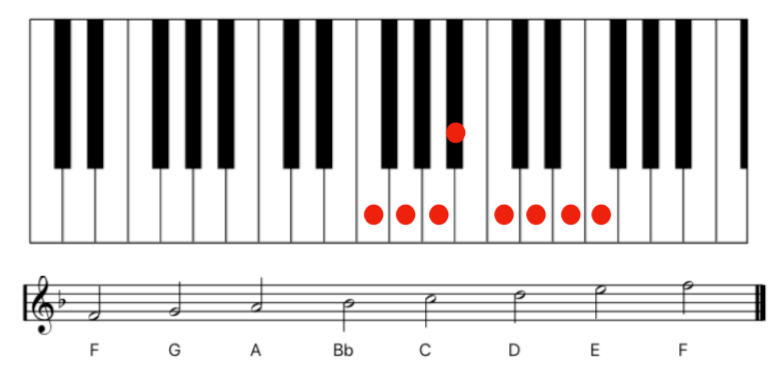
F Major – 1 flat – B
Bb Major – 2 flats – B & E

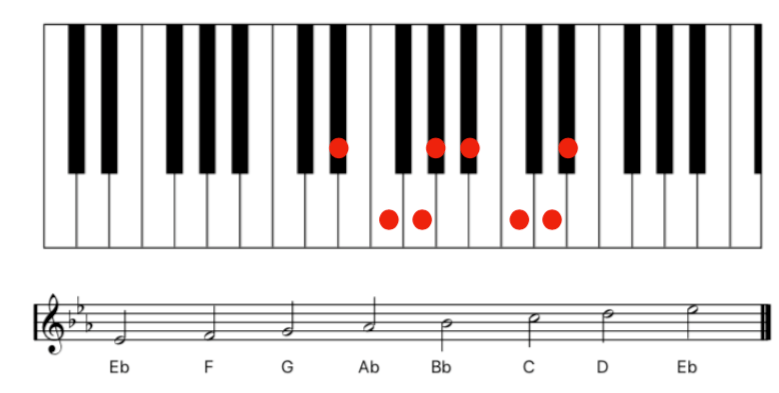
Eb Major – 3 flats – B, E & A
Ab Major – 4 flats – B, E, A & D

10. Minor keys and the cycle of 5ths
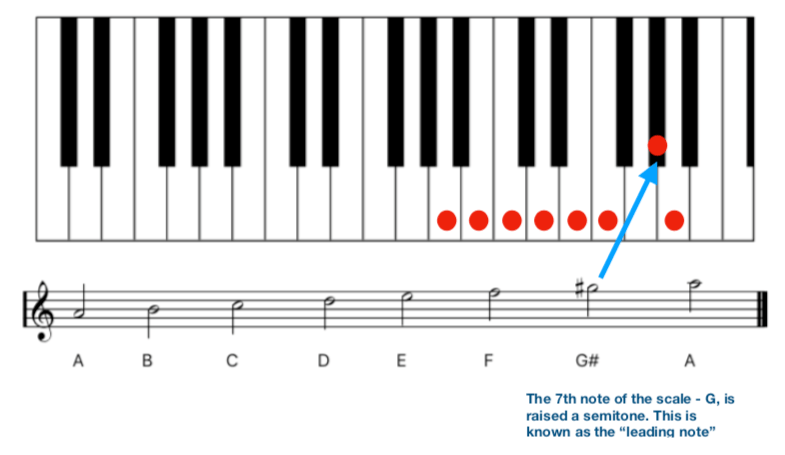
Minor scales have a different pattern of tones and semitones to major scales. Click here to see the pattern of Tones & Semitones in A minor Scale.
The cycle of 5ths also applies to minor scales – starting with A minor (Relative to C Major) jump up 5 notes or a perfect 5th to find the next minor key sign. Each minor scale is relative to a Major scale which has the same key sign. To find the relative minor scale, go down 1.5 tones or 3 semitones down from the tonic of the Major key – for example, 3 semitones down from C is A. So A minor is the relative minor of C Major.

We will just show A minor and the minor keys up to 4 sharps and 4 flats, as these are the most commonly used minor keys.
The 7th note of a minor scale is raised a semitone – this is known as the “leading note.”
A Minor Scale – has no flats or sharps in the key sign
Minor Keys with Sharps
E minor – 1 sharp – F
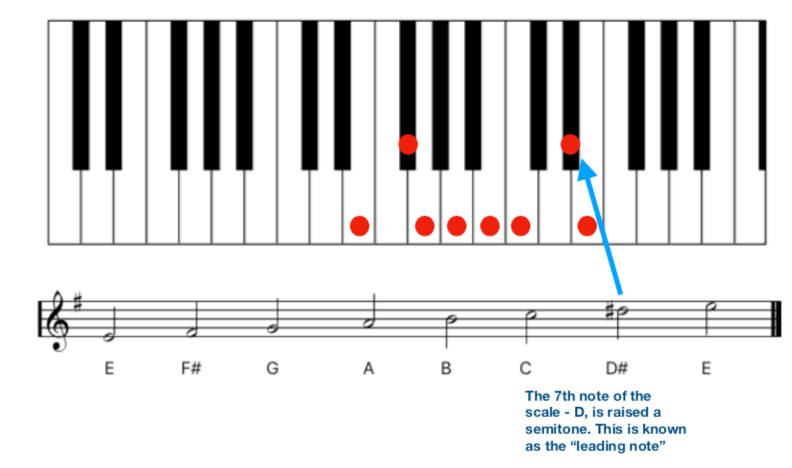
B minor – 2 sharps – F & C

F# minor – 3 sharps – F, C & G

C# minor – 4 sharps – F, C, G & D
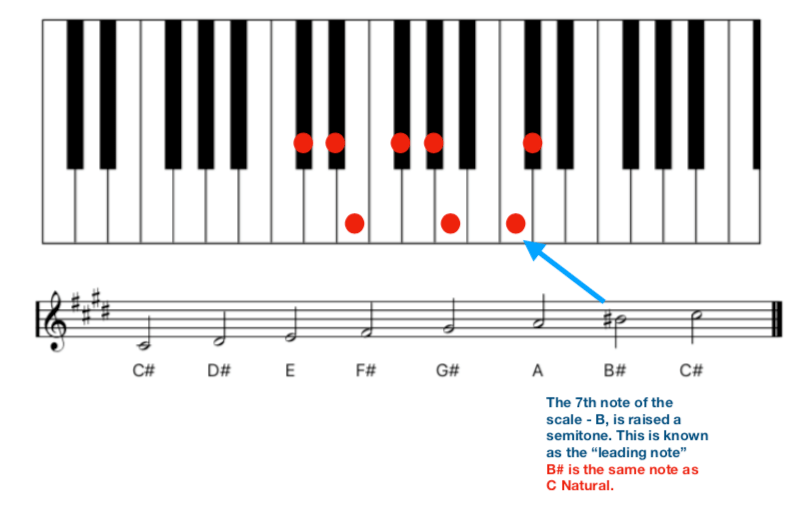
Minor Keys with Flats
D minor – 1 flat – B

G minor – 2 flats – B & E

C minor – 3 flats – B, E & A
B flat is cancelled with a natural sign to raise the 7th note of the scale by a semitone.
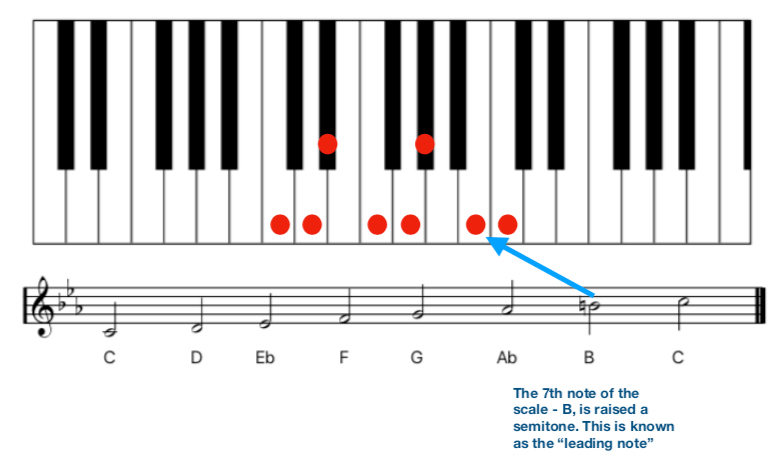
F minor – 4 flats – B, E, A and D
E flat is cancelled out with a natural to raise the 7th note of the scale by a semitone.

11. Modulation – changing key in a piece of music
Sometimes, a piece of music might change the key signature part way through – usually to the dominant (or 5th note) of the home key. Then it usually moves back again to return to the ‘tonic’ or home key. We can see this most clearly in simple hymn tunes. We will take a look at two of these hymn tunes that feature in our Flipped Strings Level 2 books and iBooks.
Modulation in “Praise My Soul”
In the hymn tune “Praise My Soul the King of Heaven”, the home key is D Major. Using the “Pivot Chord” of E Major – which is the dominant or Chord V of our new key – A Major, we can see a brief turning point or “modulation” where just for a brief moment we find ourselves in the new key of A Major – then we quickly return to the home key or ‘tonic’ – D Major.
Here is the tonic chord – the dominant of the new key or the “pivot chord”.
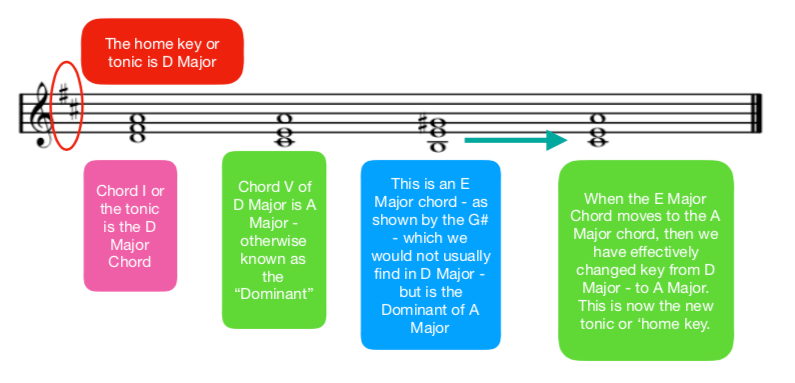
Here is how those chords work to move us briefly to the new key.
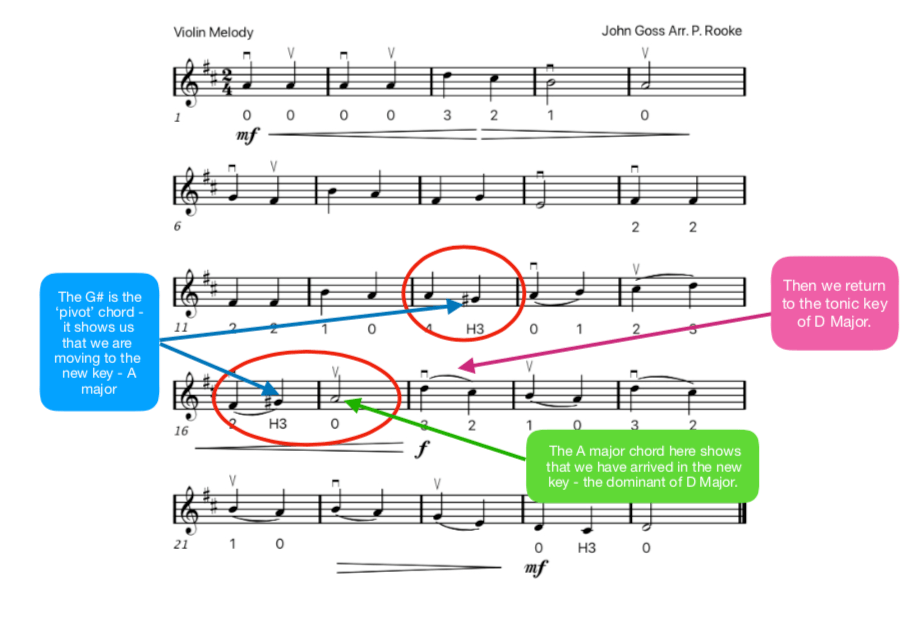
Click the play button below to listen to the violin melody
Here is an extract of the full score showing us how this modulation or key change occurs and what it sounds like.
Modulation in the hymn tune Now Thank We All Our God.
In the hymn tune “Now Thank We All Our God”, the home key is F Major. Using the “Pivot Chord” of G Major – which is the dominant or Chord V of our new key – C Major, we can see a brief turning point or “modulation” where just for a brief moment we find ourselves in the new key of C Major – then we quickly return to the home key or ‘tonic’ – F Major.
Here is the tonic chord – the dominant of the new key or the “pivot chord”.

Here is how those chords work to move us briefly to the new key.
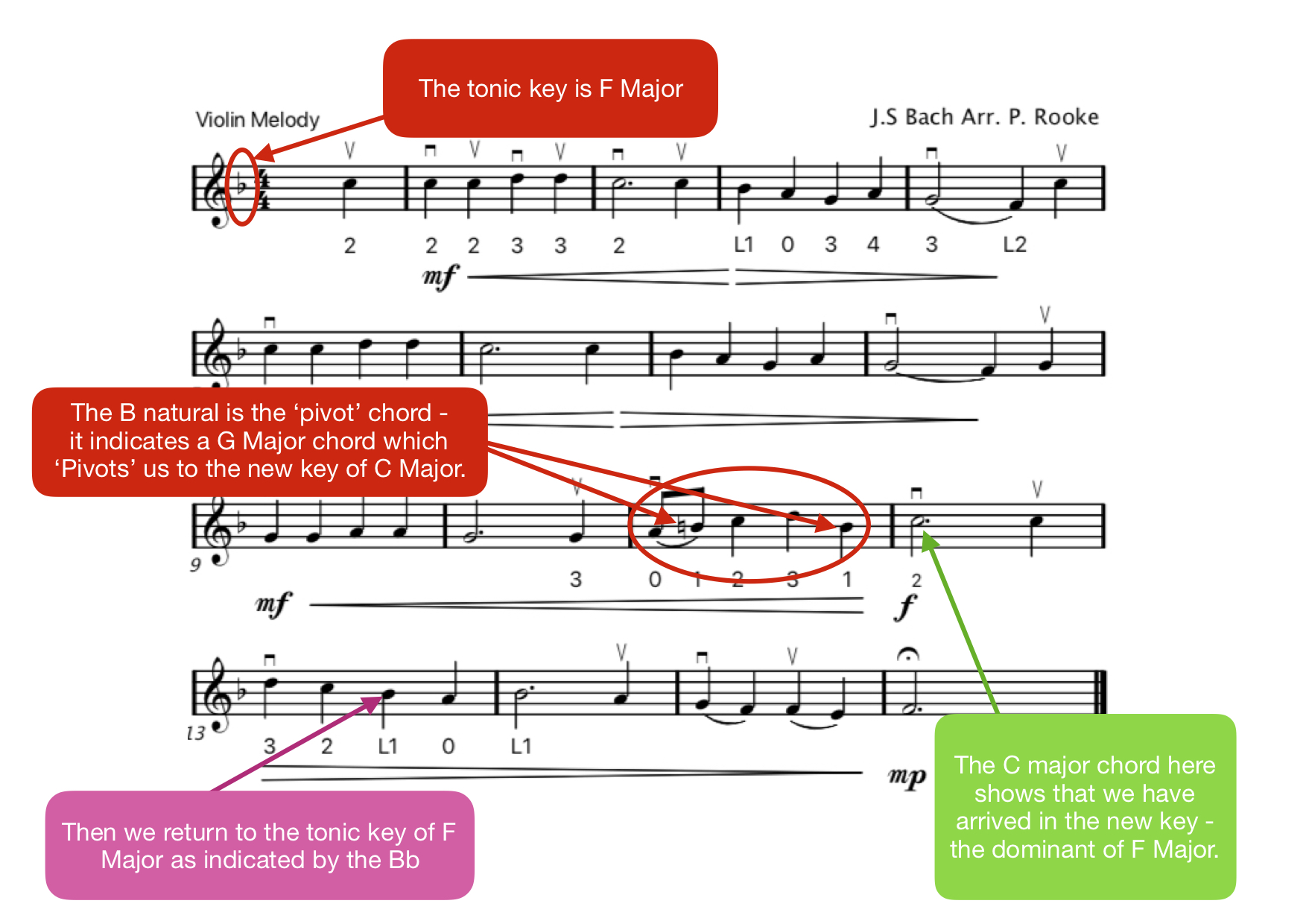
Click the play button below to listen to the violin melody
Listen to the whole string orchestra play and listen to the change of key to the dominant key of C Major in bar 12.
 Flipped Music Learning