
On this page, students can learn more about the violin and also how to read and write music for the violin
The music theory for violin students on this page correlates with the Flipped Strings Violin Book 1 and the Flipped Strings Violin Apple iBook 1 with embedded media.

Navigating this page
Click on the topic you wish to view to go to that section of this page. Teachers, you can show the videos to your class and print as many of the PDF worksheets as you wish. Students, you can work through each of the lessons, print and complete the worksheets and then play each of the exercises on your instrument, so you better understand how not only how to write music for your instrument but also how to play what you have written. This might even lead you to compose and perform your own music.
Menu – click on the topic you wish to view
- About the Violin
- The Treble Clef
- What Are Open Strings?
- 1. Writing & Reading Basic Note Values on Open Strings
- 2. Writing & Reading Rests
- 3. Writing & Reading Rhythm in Different Time Signs
- 4. Writing & Reading Rhythm – Barlines
- 5. Sharps – raising notes a semitone
- 6. Writing & Reading Notes Using 1st Finger
- 7. Writing & Reading Notes Using 2nd Finger
- 8. Writing & Reading Notes Using 3rd Finger
- 9. Writing & Reading D Major Scale & Arpeggio
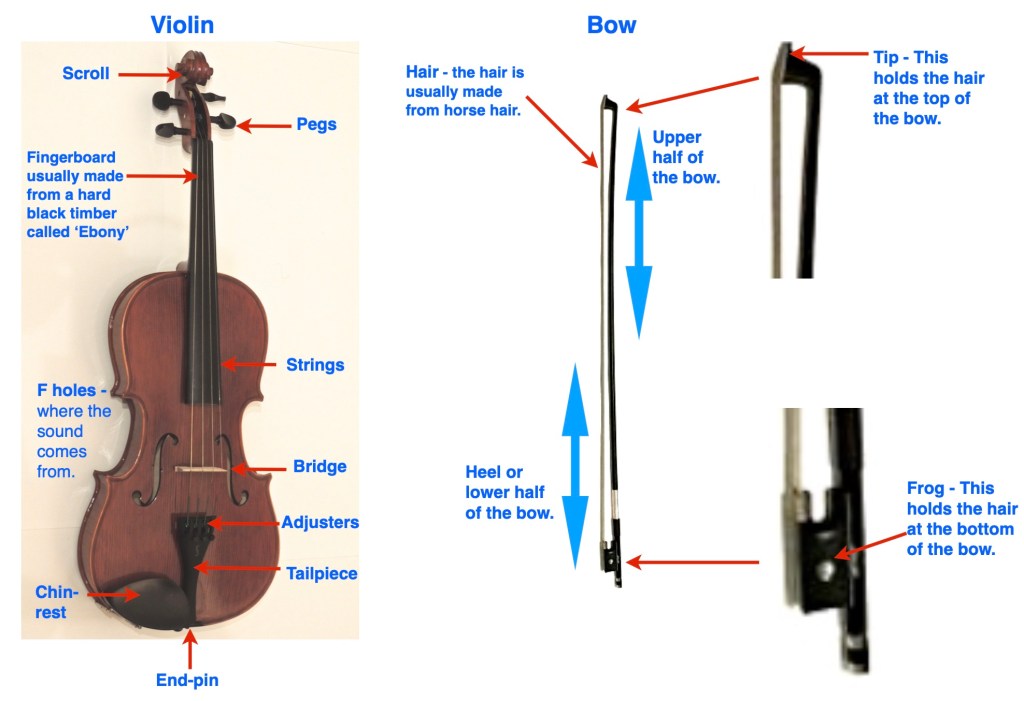
About the Violin
The violin is the highest sounding of the orchestral stringed instruments. The strings are tuned 5 notes apart. (see below)

It can be played with the bow or plucked. The violin is known as a ‘classical’ instrument but can play in Country Music, Jazz – Swing Jazz, Blues and various styles of music from other cultures such as Irish/Scottish, (Celtic) Hillbilly music, (From the Appalachian Mountains in the USA) and Rockabilly style.
The violin is known as a solo instrument in Baroque, Classical, Romantic and modern music and also plays a very important role in the orchestra.
Click Here to Return to the Menu
The Treble Clef
Music for the violin is written in the treble clef. Let’s have a look at the notes on the lines and spaces of the treble clef.


Let’s watch a video explaining the notes on the lines & spaces of the treble clef and how to draw it.
Click Here to Return to the Menu
What Are Open Strings?
The very first thing we must learn about the violin is the open strings. What is meant by “Open Strings?”
An open string on any stringed instrument is when you draw the bow across the string without placing a finger on fingerboard to change the pitch. There are 4 strings on the violin – therefore there are 4 definite fixed pitches that we can play on the violin without having to use the fingers in our left hand.

Here is the video from the Flipped Strings Level One iBook – Violin, showing how we bow crotchets on the open strings of the violin.
Click Here to Return to the Menu
1. Writing & Reading Basic Note Values on Open Strings
Click Here to Revise Note Values
Reading and Writing Semibreves or Whole Notes
Reading and Writing Minims or Half Notes
The open strings part from New World Symphony from Flipped Strings Violin Book 1 features Minims or Half Notes
Reading and Writing Crotchets or Quarter Notes
Reading and Writing Quavers or Eighth Notes
Reading and Writing Dotted Minims or Dotted Half Notes
Free Download – Worksheet # 1 Open Strings
Teachers, you can download these free worksheets and print as many copies for your students as you wish.
Click Here to Return to the Menu
2. Writing & Reading Rests
Writing & Reading Rhythms using minim or half note rests
Writing & Reading Rhythms using crotchet or quarter note rests
Writing & Reading Rhythms using quaver or eighth note rests
Writing & Reading Rhythms using a mixture of rests and notes
Free Download – Worksheet # 2 Rests
Teachers, you can download these free worksheets and print as many copies for your students as you wish.
Click Here to Return to the Menu
3. Writing & Reading Rhythm in Different Time Signs
Writing & Reading Rhythms in 4-4 time
Writing & Reading Rhythms in 3-4 time
Writing & Reading Rhythms in 2-4 time
Free Download – Worksheet # 3 Time Signatures
Teachers, you can download these free worksheets and print as many copies for your students as you wish.
Click Here to Return to the Menu
4. Writing & Reading Rhythm – Barlines
Placing Barlines in 4-4 time
Placing Barlines in 3-4 time
Placing Barlines in 2-4 time
Free Download – Worksheet # 4 Barlines
Teachers, you can download these free worksheets and print as many copies for your students as you wish.
Click Here to Return to the Menu
5. Sharps – raising notes a semitone
Using a Sharp to Raise a Note by a semitone
Using Sharps with Crotchets in a 4 – 4 Bar
6. Writing & Reading Notes Using 1st Finger
Writing & Reading the 1st Finger on G String
Writing & Reading the 1st Finger on D String
Writing & Reading the 1st Finger on A String
Writing & Reading the 1st Finger on E String
Free Download – Worksheet # 6 Using 1st Finger
Teachers, you can download these free worksheets and print as many copies for your students as you wish.
The One Finger Samba from the Flipped Strings Method Book 1 uses just the open G, D & A strings and 1st finger.
Click Here to Return to the Menu
7. Writing & Reading Notes Using 2nd Finger
Writing & Reading the 2nd Finger on G String
Writing & Reading the 2nd Finger on D String
Writing & Reading the 2nd Finger on A String
Writing & Reading the 2nd Finger on E String
Click Here to Return to the Menu
Free Download – Worksheet # 7 Using 2nd Finger
Teachers, you can download these free worksheets and print as many copies for your students as you wish.
Click Here to Return to the Menu
8. Writing & Reading Notes Using 3rd Finger
Writing & Reading the 3rd Finger on G String
Writing & Reading the 3rd Finger on D String
Writing & Reading the 3rd Finger on A String
Writing & Reading the 3rd Finger on E String
Once you master placing all 3 fingers correctly, then you should be able to easily play this study “Running on D Scale”
Free Download – Worksheet # 8 Using 3rd Finger
Once you have mastered 3rd finger on the violin, you should be able to read music and play this simple study “Running on D Scale” from the Flipped Music – Violin Book 1
Teachers, you can download these free worksheets and print as many copies for your students as you wish.
Click Here to Return to the Menu
9. Writing & Reading D Major Scale & Arpeggio
Writing & Reading D Major Scale
Writing & Reading D Major Arpeggio
Once you have mastered the D Major Scale and Arpeggio, you will be able to easily perform several pieces from the Flipped Music – Violin Book 1, such as the last piece in the book – The Water is Wide.
Free Download – Worksheet # 9 D Major Scale & Arpeggio
Teachers, you can download these free worksheets and print as many copies for your students as you wish.
 Flipped Music Learning